Unlike pitched roofs, flat roofs allow solar installers to choose the tilt angle of each PV module through the mounting structure. This flexibility creates more design options, but it also raises an important question: what is the best tilt angle for flat roof solar panels?
A steeper angle can improve sunlight exposure under certain conditions, but it may increase wind loading, row spacing requirements, and mounting costs. A lower angle can accommodate more panels within the same roof area, although it may not deliver the highest energy output per module.
For commercial and industrial rooftop projects, the best tilt angle is therefore not determined by solar radiation alone. It must balance energy generation, structural safety, available roof space, and installation costs.
1. What Is the Typical Tilt Angle for Flat Roof Solar Panels?
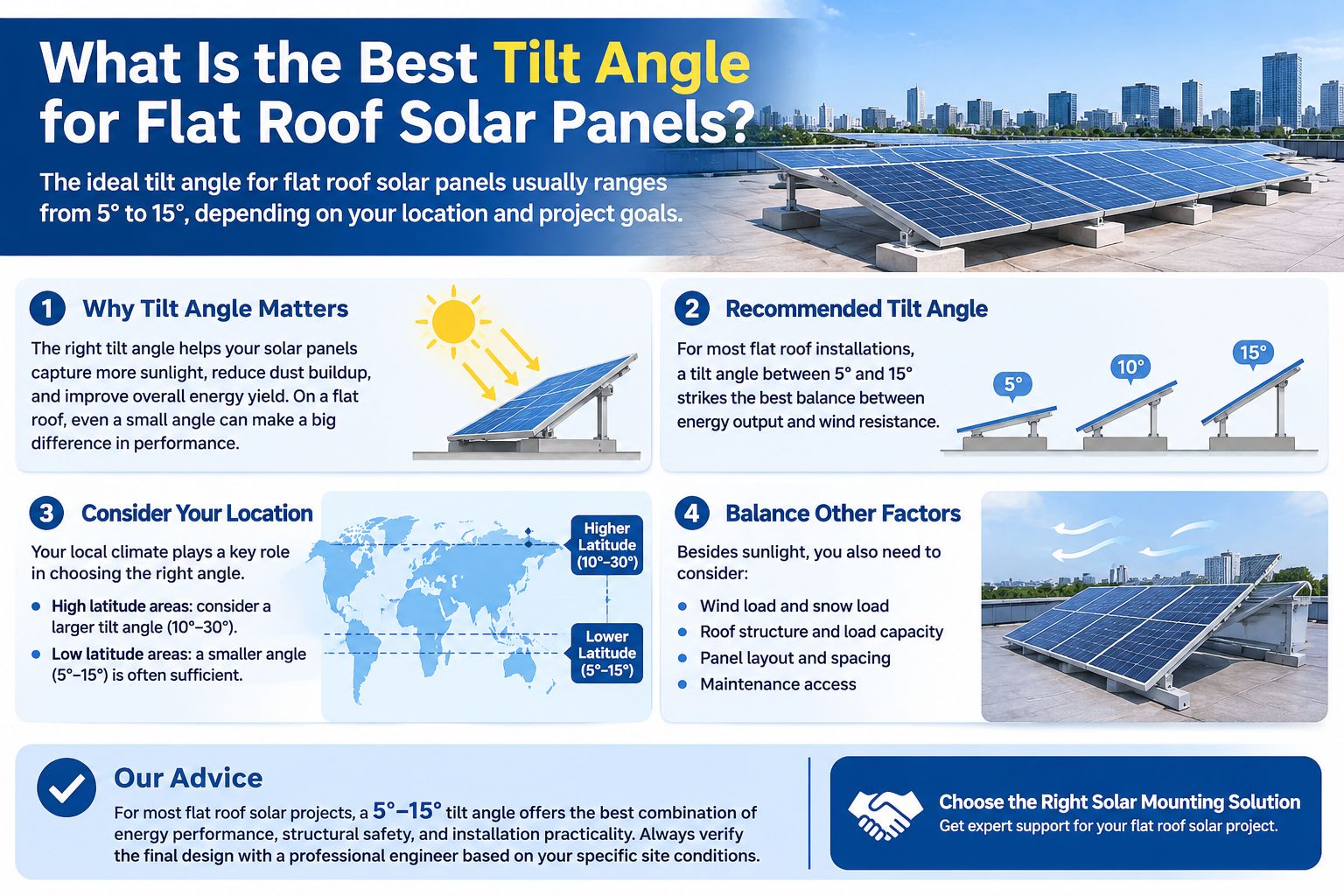
For many flat roof solar installations, tilt angles between 5° and 15° are commonly considered as a starting point for system design. However, this is a practical design range rather than a universal optimum.
The appropriate angle depends on the project location and its priorities:
5°–10°: A relatively low-profile arrangement that can help reduce wind exposure and row spacing requirements.
10°–15°: A moderate configuration that balances panel orientation, roof utilization, and structural considerations.
15°–30°: A steeper arrangement that may be considered where solar orientation and site conditions justify the additional structural and spacing requirements.
These ranges are indicative, not fixed design recommendations. A project in a high-wind coastal area may require a different solution from one in a sheltered inland location, even at the same latitude.
For example, a flat roof solar mounting system with an adjustable angle range of 5°–35° gives designers more flexibility during project planning. The final installation angle should still be confirmed through solar yield calculations and structural assessment.
2. How Does Location Affect the Best Solar Panel Tilt Angle?
Latitude is one of the main factors used to estimate an appropriate solar panel tilt angle.
As a general principle, locations farther from the equator often require a steeper panel angle to capture sunlight effectively over the year. Locations closer to the equator can often use a lower angle.
However, latitude alone does not determine the final mounting design. Local weather patterns, seasonal electricity demand, roof orientation, and the project's energy consumption profile also matter.
Low-Latitude Locations
In tropical and subtropical regions, a relatively low tilt angle may be suitable for many rooftop solar projects. Lower-profile installations can also help limit wind exposure and make better use of restricted roof areas.
Mid-Latitude Locations
Projects in mid-latitude regions may require a moderate tilt angle, depending on whether the priority is annual energy generation, seasonal output, or maximum installed capacity.
High-Latitude Locations
In higher-latitude regions, a steeper angle may improve solar exposure during certain seasons. However, the additional wind loading, row spacing, and snow-related considerations need to be evaluated before selecting the mounting structure.
For an accurate estimate, designers should use the project's geographic coordinates and solar irradiation data rather than relying on a general latitude rule.
3. Should You Choose a Higher or Lower Tilt Angle?
The decision involves more than comparing the theoretical power output of individual panels.
Advantages of a Lower Tilt Angle
A lower tilt angle can be useful when the available rooftop area is limited or when the project needs to reduce structural exposure to wind.
It may provide:
Lower wind exposure compared with a steeper arrangement, subject to the complete system design.
Reduced spacing requirements between panel rows in many layouts.
Higher potential module density on a limited roof area.
A lower-profile mounting structure.
The trade-off is that panels may receive less favorable sunlight at certain times of the year. Low-angle installations can also require attention to dust accumulation and rainwater drainage.
Advantages of a Higher Tilt Angle
A higher tilt angle can improve the orientation of modules toward the sun under suitable geographic and seasonal conditions.
It may be considered when:
The project prioritizes energy generation per module.
Sufficient roof space is available for row spacing.
Local solar conditions support a steeper configuration.
The roof structure and mounting system can accommodate the resulting loads.
The main trade-offs are increased wind exposure, potential inter-row shading, and greater demands on the mounting structure.
The important distinction is between energy generation per panel and energy generation per square meter of roof. A steeper arrangement may improve the output of an individual module but reduce the total number of modules that can be installed on the roof.
4. How Do Wind Load and Roof Capacity Affect the Tilt Angle?
For flat roof solar mounting systems, wind load is one of the most important structural considerations.
Solar panels installed above a roof are exposed to wind pressure and uplift. As the tilt angle and mounting height change, the aerodynamic forces acting on the array can also change.
This is particularly important for ballasted solar mounting systems.
A ballasted system uses concrete blocks or other engineered ballast arrangements to stabilize the PV structure. When the tilt angle increases, the wind forces and required ballast may also change. The additional weight must remain within the roof's allowable load capacity.
Before selecting a tilt angle, engineers should evaluate:
Local basic wind speed and applicable design wind pressure.
Building height and surrounding terrain.
Roof edge and corner zones.
Panel dimensions, tilt angle, and array configuration.
Ballast distribution or mechanical fixing details.
Allowable additional roof load.
Snow load also needs to be considered in regions where snow accumulation is relevant. Panel angle can influence snow movement and accumulation patterns, but it should not be used as a substitute for the required structural snow-load calculation.
For example, a project designed for a wind speed of 60 m/s and a snow load of 1.4 kN/m² must have its mounting configuration verified against those specific conditions. These values should not be treated as universal design limits.
5. How Does Tilt Angle Affect Panel Spacing and Roof Utilization?
One frequently overlooked issue is the relationship between tilt angle and row-to-row shading.
On a flat roof, solar panels are often arranged in multiple rows. When the sun is low, a panel in front can cast a shadow onto the row behind it.
Increasing the tilt angle generally increases the potential shading distance between rows. To reduce shading losses, designers may need to leave more space between adjacent rows.
This creates a practical trade-off:
Smaller tilt angle: potentially shorter row spacing and more modules per roof area.
Larger tilt angle: potentially greater solar exposure per module but more space required between rows.
The actual spacing depends on panel dimensions, orientation, site latitude, solar position, and the acceptable shading loss.
For commercial rooftop solar projects, the design objective is often to maximize total energy generation from the available roof area, rather than maximize the output of a single panel.
This is why a lower tilt angle can sometimes produce a better overall project result even when a steeper angle offers higher output per module.
6. Does Panel Orientation Change the Best Tilt Angle?
Yes. Module orientation and tilt angle should be considered together.
Flat roof solar panels are commonly installed in horizontal (landscape) or vertical (portrait) orientation, depending on module dimensions and mounting system design.
The orientation affects:
The height and footprint of the panel arrangement.
Rail positioning and clamp locations.
Row spacing and shading behavior.
The number of modules that fit within the available roof area.
For example, a landscape arrangement may create a different row depth and mounting configuration from a portrait arrangement. This can affect the overall layout even when the tilt angle remains unchanged.
The mounting rails, clamps, and support points must also match the module manufacturer's permitted fixing zones. Choosing an angle first and checking module compatibility later can lead to unnecessary redesign.
7. What Is the Best Tilt Angle for a Ballasted Solar Mounting System?
A ballasted solar mounting system needs to balance solar performance with the stability of the complete array.
Unlike a mounting structure that relies on mechanical roof anchors, a ballasted system uses ballast weight and its designed configuration to resist wind forces. Therefore, the selected tilt angle directly affects the structural design and ballast requirements.
When evaluating a ballasted solar roof mount, consider three points:
Roof load capacity: The roof must support the combined weight of the modules, mounting structure, ballast, and other applicable loads.
Wind resistance: The mounting system must be checked for the project's wind conditions, including roof edge and corner effects.
Array layout: The tilt angle should allow sufficient spacing between rows while making effective use of the available roof area.
For concrete flat roofs where roof penetration is undesirable, a ballasted mounting solution may be worth considering. However, it is only appropriate when the roof structure can safely support the required system weight.
The best angle should be established as part of the complete ballasted PV mounting design, not selected independently of the foundation and ballast arrangement.
8. How to Select the Right Tilt Angle for Your Project
Before confirming the tilt angle, project developers and solar installers should provide the mounting system supplier or engineering team with the following information:
| Design Factor | Information Required |
|---|---|
| Project Location | City, country, and geographic coordinates |
| Roof Construction | Concrete, metal deck, or other flat roof structure |
| Roof Load Capacity | Allowable additional dead load |
| Solar Modules | Module dimensions, weight, and model |
| Module Orientation | Horizontal or vertical |
| Project Objective | Maximum annual generation or maximum roof capacity |
| Wind Conditions | Local design wind speed and exposure |
| Snow Conditions | Applicable design snow load |
| Foundation Method | Ballasted or mechanically fixed |
| Roof Layout | Available area, obstructions, drainage, and maintenance access |
With these details, the design team can compare different tilt angles and evaluate their effects on energy production, panel spacing, structural loads, and total installation cost.
Conclusion: The Best Tilt Angle Is a Project-Specific Decision
For many flat roof solar installations, 5°–15° is a useful starting range. But there is no single best tilt angle for every rooftop PV project.
The final selection should account for geographic location, annual energy targets, wind and snow loads, roof capacity, panel orientation, and available installation space.
A well-designed flat roof solar mounting system should not simply maximize the tilt angle or the output of each individual module. It should achieve the right balance between total energy generation, structural reliability, roof utilization, and installation cost.
Wuxi Chenglida Machinery supplies flat roof solar mounting structures and ballasted PV mounting solutions for commercial and industrial rooftop projects. With project information such as roof construction, module specifications, design loads, and required installation angle, the mounting configuration can be evaluated according to the actual site conditions.