Two flat-roof solar projects can have very different mounting requirements, even when they use identical solar panels. A concrete roof may support a ballasted mounting system, while a lightweight metal roof may require a mechanically fixed solution. Roof height, parapets, drainage outlets, and local wind exposure can also change the final design.
For project developers, EPC contractors, and solar installers, the following considerations provide a practical way to evaluate a flat roof solar mounting system before placing an order.
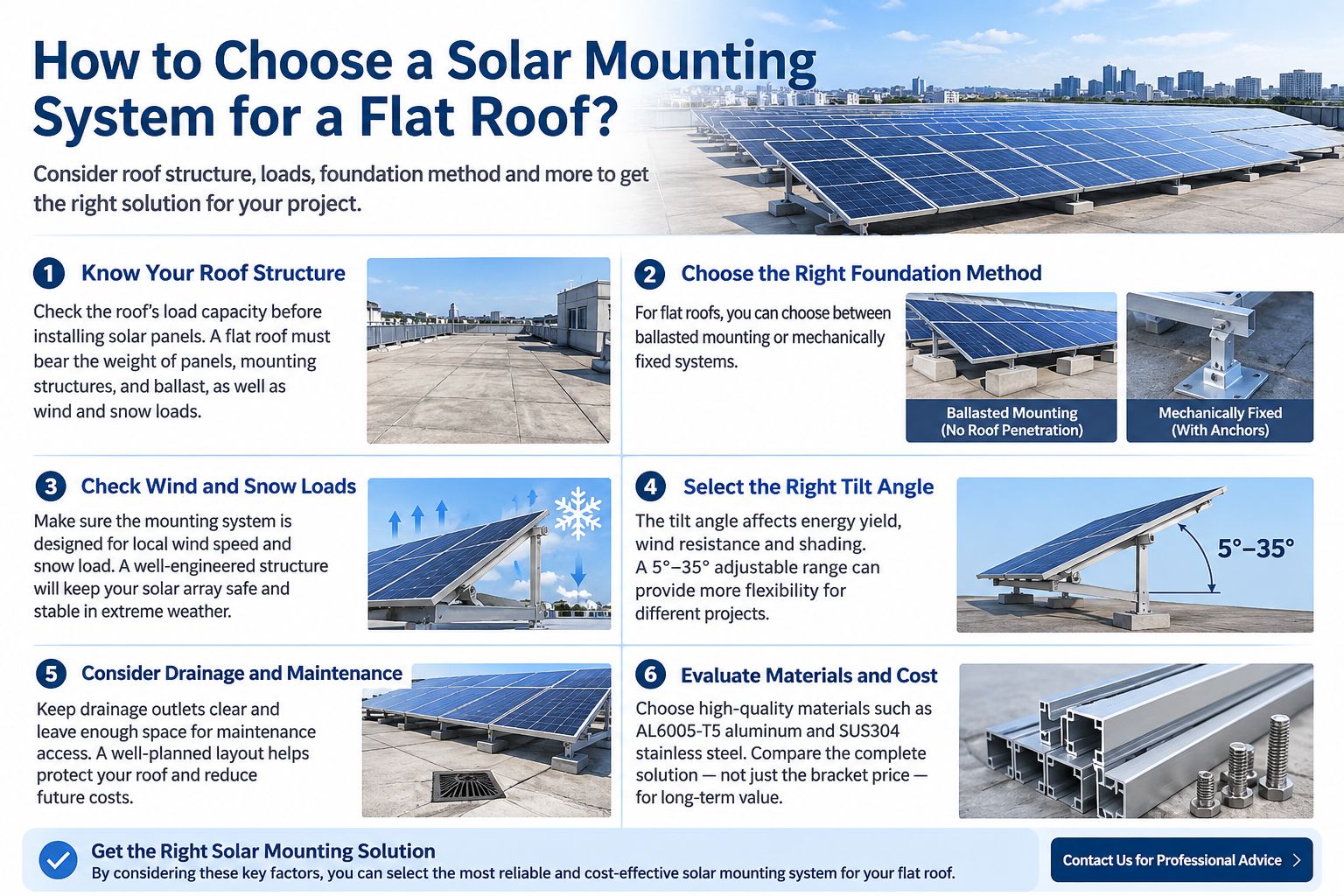
1. Start with the Roof Structure and Its Load Capacity
The first step is to understand what the roof can actually support.
A flat roof is not necessarily a strong roof. Its load-bearing capacity depends on the structural design, span, supporting beams, slab thickness, building age, and existing equipment installed on the roof.
A solar mounting system introduces several types of loads:
Dead load: The weight of solar modules, mounting rails, brackets, fasteners, and ballast.
Wind load: Wind pressure and uplift acting on the modules and supporting structure.
Snow load: Additional weight accumulated on the solar array in applicable climates.
Maintenance load: Loads associated with inspection, cleaning, and maintenance activities.
These loads need to be considered together rather than evaluated independently.
This is particularly important when selecting a ballasted solar mounting system. Concrete ballast helps stabilize the PV array, but it also adds permanent weight to the roof. A design that performs well under wind conditions may still be unsuitable if the roof cannot carry the required ballast.
Before selecting a system, obtain the available structural drawings and roof load information. If the existing documentation is incomplete, a qualified structural engineer should assess the roof before the mounting design is finalized.
2. Decide Whether to Use a Ballasted or Penetrating Mounting System
The foundation method is one of the most important decisions in flat roof solar mounting.
In general, commercial rooftop PV projects use either mechanically fixed mounting structures or ballasted mounting structures. Some projects also use hybrid solutions.
Ballasted Solar Mounting System
A ballasted solar mounting system uses concrete blocks or other engineered ballast arrangements to resist wind forces and stabilize the solar array. It can reduce or eliminate the need for conventional roof penetrations, depending on the system design.
This approach is worth considering when:
The roof waterproofing should remain largely undisturbed.
The roof structure has sufficient capacity for the mounting system and ballast.
The project requires a modular installation arrangement.
Roof penetration is restricted by the building owner or project specifications.
However, ballast weight must be calculated according to the roof conditions, array layout, building height, wind exposure, and applicable design requirements. It should never be selected using a fixed weight per panel without engineering verification.
Mechanically Fixed Solar Mounting System
A mechanically fixed flat roof solar mounting system connects the mounting structure to the roof or its supporting structure through designed anchors and fixing points.
It may be appropriate when:
The roof structure can accommodate mechanical connections.
The project needs to limit additional ballast weight.
The roof construction provides suitable fixing locations.
The engineering design requires a direct connection to the building structure.
The main consideration is waterproofing. Every roof penetration must be properly detailed and sealed according to the roofing system manufacturer's requirements.
Which One Should You Choose?
| Project Condition | Mounting Method to Evaluate |
|---|---|
| Concrete flat roof with sufficient load capacity | Ballasted mounting system |
| Roof where penetration should be minimized | Ballasted mounting system |
| Roof with limited capacity for additional ballast | Mechanically fixed system, subject to structural approval |
| Roof with suitable structural fixing points | Mechanically fixed system |
| Project with mixed structural and waterproofing requirements | Hybrid mounting solution |
There is no universally better option. The correct choice depends on the roof's structural capacity, waterproofing requirements, and project-specific wind design.
3. Check Wind and Snow Load Requirements
Wind resistance is a critical design factor for rooftop solar installations. Unlike ground-mounted systems, rooftop arrays are affected by the airflow around the building, including wind acceleration near roof edges and corners.
A mounting structure designed for an inland low-rise building may not be suitable for a coastal warehouse or a high-rise commercial building.
When evaluating a flat roof solar racking system, pay attention to:
- Basic wind speed and the applicable wind pressure calculation method.
- Building height and surrounding terrain.
- Roof edge and corner zones.
- Solar panel tilt angle and array spacing.
- Ballast arrangement or mechanical fixing details.
- Snow accumulation and local snow load requirements.
For example, a project with a specified wind speed of 60 m/s and a snow load of 1.4 kN/m² needs a mounting design verified against those project conditions. These figures should not automatically be treated as suitable for every installation.
Ask the supplier whether the proposed structure has been designed for the actual project loads and which design standards are being applied. Standards such as AS/NZS 1170 and JIS C 8955 may be relevant depending on the project location and engineering requirements.
4. Select the Right Tilt Angle and Panel Layout
The tilt angle affects solar exposure, row spacing, wind loading, and the number of modules that can fit on the roof.
A higher tilt angle may improve solar orientation in certain locations, but it can also increase wind exposure and create greater shading between adjacent rows. A lower angle may allow a denser layout, although the energy yield and self-cleaning performance need to be considered in the project design.
For a flat roof solar panel mounting system, the designer should evaluate:
- Project location and solar orientation.
- Required energy generation and module arrangement.
- Available roof area.
- Row-to-row shading.
- Roof parapets and nearby obstructions.
- Wind load implications of the selected tilt angle.
Some systems use a fixed tilt angle, while others support adjustable configurations. For example, a mounting structure with a 5°–35° installation angle range provides more flexibility for project layout, but the final angle must still be confirmed through structural and solar design calculations.
Panel orientation also matters. Depending on module dimensions and the rail arrangement, modules may be installed in horizontal or vertical orientation. The selected configuration should match the mounting structure rather than being decided only by the available roof space.
5. Consider Roof Drainage, Waterproofing, and Maintenance Access
A solar array should not interfere with the roof's basic functions.
Flat roofs rely on designed slopes, drainage outlets, and waterproofing layers to manage rainwater. If mounting components obstruct drainage paths or create areas where water accumulates, long-term roof problems may develop.
Before confirming the mounting layout, check:
Drainage clearance: Keep drainage outlets and water flow paths accessible. Do not position ballast blocks or support components where they obstruct roof drainage.
Waterproofing protection: Ballasted systems can reduce roof penetrations, but the support points and ballast still need suitable contact protection to avoid damaging the waterproofing membrane.
Maintenance access: Leave practical access routes for inspecting modules, electrical equipment, drainage outlets, and roof surfaces.
Roof equipment clearance: Account for HVAC units, ventilation equipment, skylights, pipes, and other rooftop installations.
These details are easy to overlook during initial layout planning. However, they can affect installation work, future maintenance costs, and the usable area of the roof.
6. Evaluate Materials and Corrosion Protection
The materials used in a solar panel mounting system for flat roofs affect structural performance, corrosion resistance, and long-term maintenance.
Aluminum alloy is commonly used for PV mounting rails and supporting components because of its relatively low weight and suitability for outdoor applications. AL6005-T5 is one material option for solar mounting structures, often supplied with an anodized surface finish.
Stainless steel fasteners are also widely used for connections exposed to outdoor conditions. SUS304 stainless steel is a common option, although the appropriate grade should be evaluated according to the actual environment.
For projects in coastal areas, industrial environments, or locations with high humidity, material selection deserves additional attention. The corrosion performance of the complete assembly depends not only on the main bracket material but also on fasteners, connections, surface treatment, and contact between dissimilar metals.
When reviewing a supplier's proposal, confirm the material grade and surface treatment of the main structural components instead of relying on general descriptions such as corrosion-resistant aluminum.
7. Confirm Module Compatibility and Installation Details
A mounting system must match the solar modules and the installation method specified for the project.
Before ordering a flat roof PV mounting system, confirm:
- Module dimensions and frame configuration.
- Framed or frameless module compatibility, where applicable.
- Horizontal or vertical module orientation.
- Rail and clamp compatibility.
- Required tilt angle.
- Connection and fastening arrangements.
Do not assume that a mounting structure suitable for one module size will automatically fit another. Changes in module dimensions can affect rail positioning, clamp locations, support spacing, and overall array layout.
It is also useful to check the level of factory pre-assembly. Pre-assembled components can reduce the number of individual installation operations on site, but the actual benefit depends on packaging, transport conditions, and how much assembly is still required during installation.
8. Compare the Complete Project Cost, Not Just the Bracket Price
The lowest unit price does not necessarily mean the lowest project cost.
When comparing suppliers of flat roof solar mounting systems, consider the complete installation cost, including:
- Mounting rails, brackets, clamps, and fasteners.
- Concrete ballast or mechanical anchoring components.
- Roof protection and waterproofing work.
- Transportation and packaging.
- On-site labor and installation time.
- Engineering design and project-specific adjustments.
- Future inspection and maintenance requirements.
For a ballasted system, the amount of concrete ballast can significantly affect transportation, handling, and roof loading. For a mechanically fixed system, roof penetration details and waterproofing work may add to the installation cost.
A useful comparison should therefore be based on the complete mounting solution and its compatibility with the roof, rather than the price of individual brackets.
What Information Should You Send to a Solar Mounting System Supplier?
Providing accurate project information helps the supplier recommend a suitable structure and prepare a more reliable quotation.
For an initial technical evaluation, prepare the following information:
| Project Information | Details to Provide |
|---|---|
| Roof type | Concrete roof, metal roof, or other flat roof construction |
| Roof drawings | Structural drawings or available roof specifications |
| Roof load capacity | Allowable additional dead load, if available |
| Project location | City, country, and relevant wind and snow conditions |
| Solar modules | Module dimensions, weight, and model |
| Module layout | Horizontal or vertical orientation |
| Tilt angle | Required angle or preferred range |
| Foundation preference | Ballasted, mechanically fixed, or open to recommendation |
| Project capacity | Planned PV system capacity or module quantity |
| Applicable standards | Local building and structural design requirements |
With this information, the supplier can evaluate the mounting configuration, foundation method, material requirements, and project-specific design conditions more effectively.
Final Considerations
Choosing the right solar mounting system for a flat roof requires more than comparing bracket materials and tilt angles. The roof's load capacity, foundation method, wind and snow conditions, drainage arrangement, and module layout all influence the final solution.
For concrete flat roofs where roof penetration should be minimized, a ballasted solar mounting system may be worth evaluating, provided the roof can safely support the required ballast. Where additional ballast is not practical, a mechanically fixed solution may be more appropriate if suitable structural connections are available.
At Wuxi Chenglida Machinery, we supply photovoltaic mounting structures and accessories for different rooftop and ground-mounted solar applications. Project requirements such as roof construction, module configuration, installation angle, and design loads can be used as the basis for evaluating a suitable mounting solution.