At Wuxi Chenglida Machinery Co., Ltd., we've manufactured both aluminum and steel PV mounting systems for projects across coastal Vietnam, arid Saudi Arabia, and temperate European rooftops. One question comes up in nearly every technical consultation: "Which material actually delivers better long-term value?" After supporting 200+ installations, we've learned the answer isn't about picking the "stronger" option-it's about matching material properties to your project's specific realities.
- Corrosion resistance: where environment dictates the winner
On a port-side project in Zhejiang, salt mist exposure was the dominant concern. We specified 6005-T5 aluminum brackets with Type II anodizing (≥15μm). Three years later, inspection showed zero structural corrosion-even at cut edges we'd sealed with factory-applied coating. By contrast, a nearby ground-mount using standard hot-dip galvanized steel required touch-up repairs at connection points after just 18 months. Aluminum's natural oxide layer provides inherent protection; steel relies entirely on coating integrity. In high-humidity, coastal, or industrial zones, this difference often determines maintenance frequency-and total cost of ownership.
- Structural performance: strength isn't always the priority
Steel has higher yield strength, yes-but that advantage only matters if your design actually requires it. For a lightweight commercial rooftop in Vietnam, aluminum's ~240 MPa yield strength (6005-T5) was more than sufficient to handle 50m/s wind loads, while its 65% lower weight eliminated costly roof reinforcement. Conversely, for a utility-scale ground mount in Inner Mongolia with heavy snow loads and 30m span requirements, we engineered reinforced galvanized steel frames. The key insight? Use structural modeling-not assumptions-to determine whether aluminum's strength-to-weight ratio or steel's raw rigidity better serves your load case.
- Installation efficiency: where aluminum saves real time and money
On a distributed solar project in the Philippines, our aluminum rail system allowed two installers to handle 6-meter sections without lifting equipment. Average bay assembly time: 22 minutes. A comparable steel system, tested on an adjacent site, required three crew members and took 34 minutes per bay-primarily due to weight and handling complexity. Over a 5MW project, that difference translated to ~120 saved labor days. Aluminum's lightweight nature doesn't just ease installation; it reduces safety risks, equipment needs, and schedule pressure. For projects with tight timelines or limited skilled labor, this operational advantage often outweighs marginal material cost differences.
- Thermal behavior: a subtle but critical factor
Aluminum's coefficient of thermal expansion (~23 µm/m·℃) closely matches that of glass PV modules. In regions with large daily temperature swings-like the Gobi Desert, where we've deployed systems facing 50℃+ fluctuations-this compatibility minimizes micro-stress on module frames and glass. Steel expands less (~12 µm/m·℃), which can create differential movement at connection points if not carefully engineered. We've seen cracked module frames traced back to poorly accommodated thermal mismatch. It's a detail most spec sheets overlook-but one that directly impacts long-term yield and warranty claims.
- Lifecycle cost: looking beyond the invoice
A client in Indonesia once chose galvanized steel to reduce upfront spend. Within two years, humidity-driven coating degradation triggered unplanned maintenance visits. When we recalculated total cost of ownership-including labor, downtime, and replacement risk-the aluminum alternative (with hard anodizing) proved 18% more economical over a 10-year horizon. At Chenglida, we now include a simple lifecycle estimator in every proposal. In corrosive or hard-to-access sites, investing 10–15% more in material quality can reduce OPEX by 40% or more.
So, which should you choose?
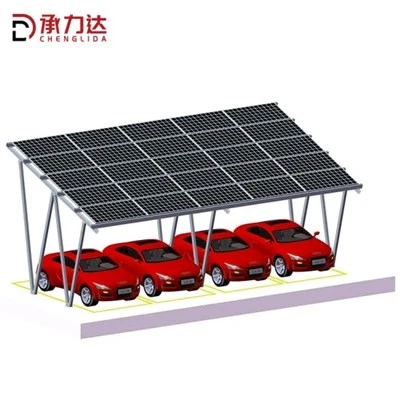
✅ Choose aluminum if: your site is coastal, humidity-prone, weight-sensitive, or requires fast, low-skill installation. Ideal for rooftops, carports, and distributed solar.
✅ Choose steel if: you need maximum rigidity for ultra-long spans, face extreme snow loads, or operate in dry, low-corrosion environments with budget-driven procurement.
One final note: engineering matters more than material
Even the best alloy underperforms with poor design. Galvanic isolation, proper torque specs, drainage planning, and thermal movement accommodation determine real-world longevity. At Chenglida, we don't sell "aluminum" or "steel." We engineer site-specific solutions-validating every choice against your wind maps, roof drawings, and ROI targets.
If you're evaluating mounting options and want a no-obligation material comparison-including corrosion modeling, structural verification, and lifecycle cost projection-just share your project basics. We'll send you a field-tested recommendation, not a generic spec sheet.
Wuxi Chenglida Machinery Co., Ltd. - Engineering PV mounting systems that perform reliably, year after year, in the conditions that matter most.